Fuel theft leaves a trail
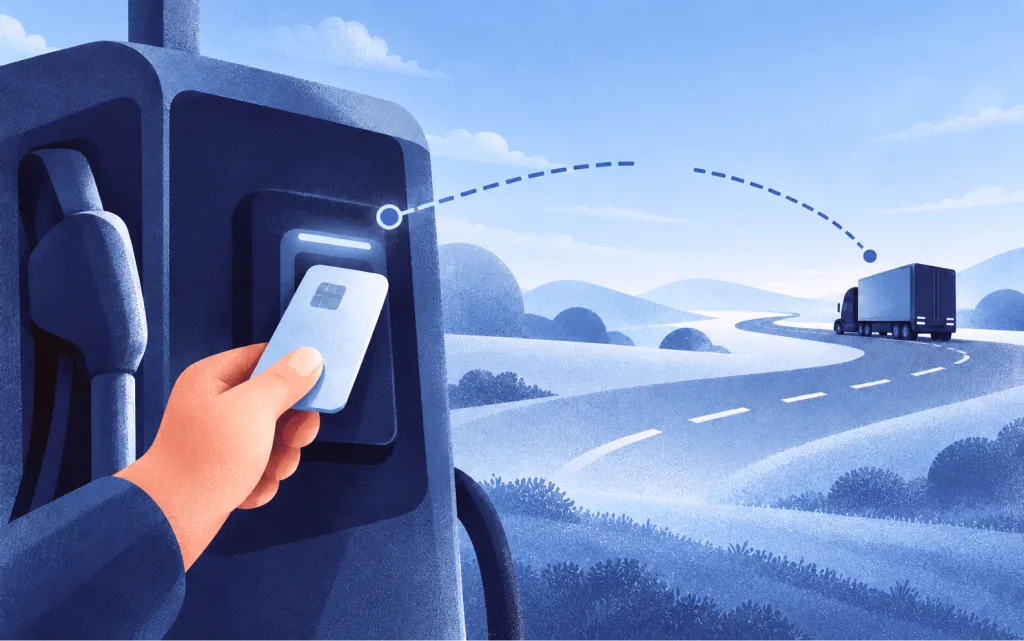
Fuel card fraud rarely shows up on a single receipt. Stolen fuel usually goes through on ordinary receipts, at truck stops on the route and on the right driver’s card. You find it by putting each receipt next to another record, such as where the truck’s ELD says it was at that minute.
“Moonin caught me a fuel fraud I didn’t notice. A driver was stealing fuel worth $2000 each week!”
At last week’s national average of $6.18 a gallon,1 $2,000 buys about 320 gallons of diesel. Over a year that comes to $104,000, more than the fuel two average tractor-trailers burn in a year at today’s price.2
What a small leak costs at $6 diesel
In 2025, fuel was about a fifth of what it cost to run a truck. ATRI’s 2026 cost study, which covers that year, put fuel at about 48 cents a mile out of $2.34 in total costs.3, 4 Diesel cost under $4 a gallon for most of that year.
Diesel has climbed since. The weekly U.S. average set a record of $6.53 in late September, and on October 12 it was $6.18, up $2.51 from a year earlier.1 The average combination truck got 7.1 miles per gallon in 2024,2 so fuel now costs about 87 cents a mile.
That average truck burned 7,771 gallons in 2024, or about $48,000 of diesel at today’s price.2 A 1% leak is only a gallon and a half a week per truck, small enough to hide in normal day-to-day variation. Across 20 trucks it adds up to about $9,600 a year, money that comes straight out of your trucking cost per mile. Long-haul trucks run far more miles than that average, so the exposure for an over-the-road fleet is higher.
How fuel card fraud usually happens
Fuel card companies and court records describe the same few schemes over and over.
- Fueling something else on the company card. A personal pickup, a friend’s truck, or containers that get resold later. A fill-up bigger than the truck’s tanks is the usual sign.5
- Selling fuel at the pump. The driver swipes the card and lets another truck fill up for cash.6
- Fake or padded transactions. A station employee rings up fuel that was never pumped and splits the money, or a driver uses the card to get cash.5 In July 2026 a West Virginia truck driver pleaded guilty to wire fraud after setting up fictitious “service stations” on online payment platforms and charging $510,465 to his employer’s fuel cards.7
- Reefer fuel billed as truck fuel. An executive at a fuel card company told FreightWaves that this happens often, and that it throws off IFTA accounting too.6
- Skimmed or cloned cards. Here the thief is outside the company. Transport Topics reported two fleets losing between $10,000 and $60,000 a month to skimming at the worst point.8 In 2025 New Jersey charged 25 people in a ring that cloned cards, bought diesel, and resold it to trucking companies.9
- Odometer and PIN games. Entering the same odometer reading every time, or using someone else’s driver ID, hides who bought what. A 2025 audit of the City of Richmond’s fuel cards found one employee who entered an odometer reading of “1” on 266 transactions.10
Keep the skimming cases in mind before you talk to anyone. If a card was cloned, the driver whose name is on the transaction did nothing wrong.
Five checks to run on data you already have
You need two exports for most of these: fuel card transactions with the time, location, gallons, product, and odometer for each purchase, and the ELD or GPS history for each truck. Fuel card portals and ELD systems can usually export both to a spreadsheet.
| Check | What you compare | Worth a closer look when |
|---|---|---|
| Location | Where the card was used and where the truck was at that minute | The truck was miles away, or parked with the engine off |
| Volume | Gallons bought and the unit’s tank capacity | One fill is bigger than the tanks can hold |
| Fuel economy | Each truck’s miles per gallon and its own history | It drops and stays down with no mechanical reason |
| Timing | Purchase times, duty status, and other fills | Fuel bought off duty, or two swipes minutes apart |
| Paperwork | Odometer, product, and card details on each receipt | Odometer repeats or goes backward, the wrong fuel type, charges on a “lost” card |
1. Was the truck at the pump?
Match each purchase to where the truck was at that minute. Tools that automate this use a tight window. Samsara’s fuel card integration looks for the vehicle within 100 meters and 10 minutes of the purchase,11 and AtoB lets fleets decline purchases made more than 100 meters from the assigned vehicle.12 By hand, you can be looser. A truck a block away is noise. A truck in another city, or parked at the yard with the engine off, is a question to ask.
A location match doesn’t clear a purchase. It only shows the truck was at the station, and the fuel could still have gone into another tank.6
2. Did the gallons fit the tanks?
Look up each unit’s tank capacity on its build sheet, since it varies from tractor to tractor. Any single purchase larger than that needs an explanation.13 If your telematics reports fuel level, a big fill on a tank that already read nearly full needs one too.11, 14
3. Is one truck’s fuel economy drifting?
Divide miles driven by gallons bought, per truck, per week, and compare each truck with its own history. The fleet average is a poor yardstick, because loads, routes, and equipment all move the number. WEX’s fleet card guide also points out that a change in fuel economy can mean the truck needs repairs.13 One bad week means little, because partial fills push gallons from one week into the next. If a truck’s fuel economy falls and stays down for several weeks, and the shop finds nothing wrong, look closer at its fuel purchases. The same gallons feed your IFTA return, so a truck that seems to burn too much is also an audit question.
4. Was the truck working when it was fueled?
Line up purchases against duty status and the day’s route. Purchases outside the truck’s usual hours, several fills on one unit in a single day, and two swipes within minutes of each other all appear on WEX’s and Element’s lists of warning signs.5, 13 In the West Virginia case, investigators pointed to the same kind of mismatch: the driver’s regular routes almost never required fueling away from the company’s facility.7
5. Does the paperwork hold together?
Read the receipts as data. Odometer readings that repeat, go backward, or are missing are a common sign, and Element notes that ghost transactions often have no odometer reading at all.5 Gasoline on a diesel unit, food or other non-fuel items on a fuel card, and charges made while a card was reported lost also deserve a second look.13, 14
Check a mismatch before you act on it
Many mismatches have ordinary causes. Rule these out before you treat one as theft:
- Bad station coordinates. Fuel card networks sometimes have the wrong GPS location on file for a truck stop. Geotab added a separate flag for this in 2026 because it was creating false location mismatches.15
- Typos. A driver who types tenths of a mile turns 60,000 miles into 600,000.16
- The wrong name on the purchase. A card used in a swapped truck, or a shared PIN, puts the transaction under someone who wasn’t there.10
- Gaps in the truck’s data. If the ELD lost power or signal, the truck can look parked when it wasn’t.
- Partial fills and team drivers. Both move gallons between days and drivers, which makes one week’s numbers look strange.
- Product codes. Truck stops code diesel in different ways, so a “wrong product” flag can just be a coding difference.17
Then work through it in order:
- Pull both records: the fuel transaction, and the truck’s location and duty status for that hour.
- Look for an ordinary explanation from the list above.
- Look for a pattern. One odd purchase is noise. The same kind of mismatch on the same card for several weeks is a pattern.
- If the card might have been skimmed, cancel it and call the card company before you talk to anyone.
- Talk to the driver with the records in front of you, and write down what you found and what they said.
- Decide what happens next, and get advice first if any money will be held back.
That last step has legal limits. The rules on deducting suspected theft from an employee’s pay differ by state.18 For leased owner-operators, federal leasing rules require the lease to spell out what can be deducted from their pay and to give them copies of the documents behind each charge.19 Federal law also bars most employers from requiring a lie detector test.20 None of this is legal advice, so talk to an attorney before you withhold pay or end a lease.
How to prevent fuel card fraud next time
Most fleet card programs offer these controls. Check which ones your account actually has switched on.12, 13, 17
- A driver ID and PIN on every swipe, checked against your driver list, with new PINs when someone leaves.
- Prompts for the unit number and odometer, so every purchase is tied to a truck.
- Diesel-only limits on tractor cards, with reefer fuel on its own card or product code.
- A gallon limit per purchase that fits each unit’s tanks, plus daily limits.
- Blocks on stations you never use, and on hours when your trucks don’t run.
- Real-time alerts, and a way to suspend a card from your phone.
- Where your card and telematics providers support it, an alert or a decline when the truck isn’t at the pump.11, 12, 14
Card rules stop the easy cases. A cloned card or a padded receipt can still pass every one of them, so keep running the record checks too.
Write it down in a fuel card policy
Drivers follow rules they have seen in writing. A one-page fuel card policy, signed when a driver gets a card, can cover:
- Each card is for one driver and the assigned truck, and the PIN is never shared.
- Enter the unit number and the real odometer reading at every swipe.
- Diesel for the tractor only, with reefer fuel and DEF on their own code or card.
- Report a lost or stolen card right away, by phone and in writing.
- Receipts go in within a set time, and purchases that don’t match a trip get asked about.
- What happens when the rules are broken, written plainly and the same for everyone.
For leased owner-operators, any fuel charges you plan to deduct need to be spelled out in the lease itself.19
When checking by hand stops working
With a few trucks, a weekly spreadsheet is enough. Export the week’s fuel transactions and the ELD history, and check each purchase against where the truck was. The work grows with every truck and every card, and it is the kind of job that slips in a busy week.
Moonin runs this check every day. It reads your fuel card transactions alongside your ELD data, and when two records disagree it shows you both, along with when it found them. It flags without accusing anyone, and nothing goes to a driver or anyone else until you approve it. Setup takes under two days, and on the first call we confirm which fuel card and ELD systems we can connect for your fleet. The same ELD records also show how long trucks sat at each stop, which is the proof you need to collect detention pay. If you want to see it on your own trucks, book a call.
Sources
- U.S. Energy Information Administration, Gasoline and Diesel Fuel Update, on-highway diesel, week of October 12, 2026 (released October 14, 2026), and the weekly price history.
- Federal Highway Administration, Highway Statistics 2024, Table VM-1, combination trucks (page updated February 2, 2026).
- American Transportation Research Institute, New ATRI report details accelerating costs and low profitability despite cuts, July 15, 2026, on the 2026 update of An Analysis of the Operational Costs of Trucking.
- FleetOwner, Trucking operational costs hit record $2.336 per mile, ATRI reports, July 22, 2026.
- Element Fleet Management, Discover key fleet fuel fraud prevention strategies, April 17, 2025. Element is a fleet management and fuel card company.
- FreightWaves, How carriers can prevent fuel fraud at the pump before it happens, June 10, 2025, quoting Rich Taute of QuikQ, a fuel card company.
- FreightWaves, Truck driver admits $510K fuel card fraud without buying fuel, August 6, 2026.
- Transport Topics, Fleets, suppliers work to curb fuel card skimming, February 5, 2024.
- New Jersey Office of the Attorney General, Attorney General Platkin announces charges against 25 people, four companies, in large-scale diesel fuel theft scheme, January 16, 2025.
- The Richmonder, Audit of city fuel cards finds at least $44K in ‘questionable’ spending, July 1, 2025.
- Samsara, Fuel card integration, developer documentation, updated October 22, 2025.
- AtoB, frequently asked questions on card controls and location-based declines.
- WEX, I have a fleet card: now what (PDF guide).
- Motive, Fortify your fleet with new AI-powered fraud controls from Motive, December 5, 2024, and How our new Motive Card feature helps fleets identify and reduce fuel theft, October 16, 2023. Motive sells a fuel card, and its loss figures are its own estimates.
- Geotab, Station Location Data Error Flag, product update, August 12, 2026.
- Government Fleet, IT for Fleet Managers: Part 5, July 1, 2005.
- EFS, eManager quick reference guide (PDF), card prompts, limits, and product codes.
- Hunton Andrews Kurth, Employee theft: can employers deduct suspected or known theft from an employee’s paycheck?, March 20, 2018. General information, not advice for your state.
- 49 CFR 376.12(h), Lease requirements, paragraph (h) on chargebacks to owner-operators.
- U.S. Department of Labor, Fact Sheet #36: Employee Polygraph Protection Act of 1988.

The Moonin teamMoonin, Mason, Ohio