What waiting costs a fleet
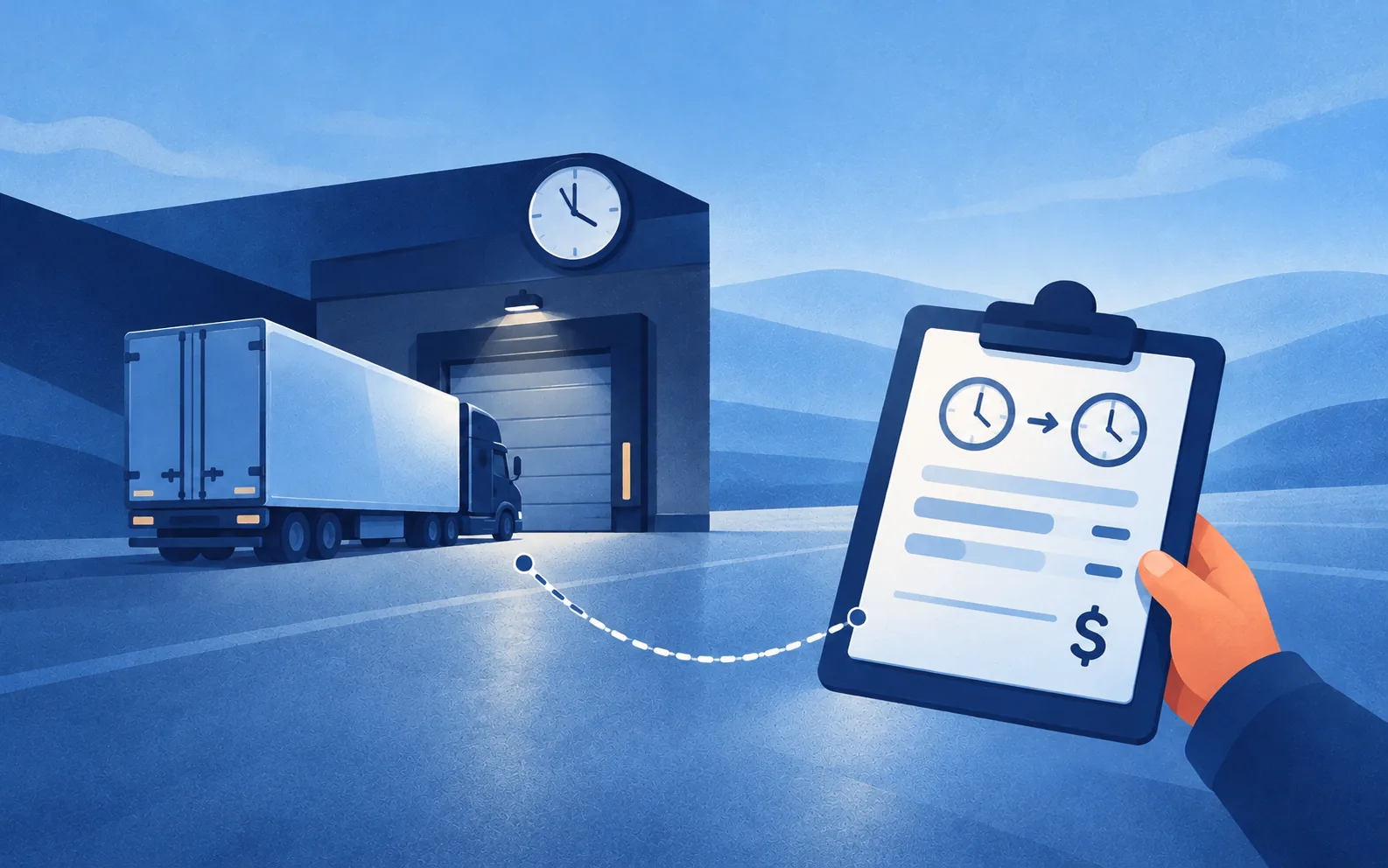
Detention pay is meant to cover the hours a truck waits at a shipper or receiver past its free time. ATRI counts detention as any time at a customer’s facility beyond two hours. By that measure, drivers were detained at 39.3% of stops in 2023, and at one stop in ten the detention itself ran past two more hours.1
The cost adds up quickly. ATRI estimated that detention cost for-hire carriers $11.5 billion in lost revenue in 2023, plus $3.6 billion in expenses nobody reimbursed. For a truckload carrier that came to about $13,455 in lost revenue and $5,104 in unreimbursed costs per truck per year,1 all of it landing on your trucking cost per mile. Multiply that by 20 trucks and the unreimbursed costs alone pass $100,000.
Some freight waits longer than other freight. Reefer loads hit detention at 56.2% of stops, and spot loads at 42.5% compared with 33.8% for contract freight.1 The waiting also costs on the road afterward. A federal audit found that every extra 15 minutes of average dwell time raised the expected crash rate by 6.2%,2 and ATRI found that drivers drove 14.6% faster on average after being detained.1 Crashes and violations end up in the safety record your insurer reads at your truck insurance renewal.
Why most detention pay never gets collected
Carriers sent an invoice for 75% of detention incidents in ATRI’s survey, and 55% of those invoices were paid.1 That leaves roughly four detention incidents in ten paid and six unpaid. Owner-operators report the same thing. In the OOIDA Foundation’s 2023 survey, only 49% said they always try to collect detention, and 17% said they collect none at all.3
Even when it is paid, detention pays less than driving. ATRI’s median detention fee in 2023 was $50 an hour for truckload carriers, while an hour on the road earned about $99.54 before fuel.1
Most unpaid claims fail on the same few details:
- The truck was late. Carriers often can’t bill detention when the driver missed the appointment.1
- The clock started earlier than you thought. Free time often counts from the appointment, not from when the truck pulled in.4
- The paperwork doesn’t match. C.H. Robinson’s system rejects a detention request when the times entered don’t match the uploaded paperwork.5
- The claim went in too late. Brokers usually want the claim within 24 to 48 hours.4
Know the terms before the truck arrives
Every rate confirmation sets its own rules for detention. Read these terms on the rate confirmation before you book the load.
| Term | What to look for | Example |
|---|---|---|
| Free time | How long you wait before detention starts | Two hours is most common: 67% of carriers that charge detention start at two hours.1 |
| Clock start | Appointment time or arrival time | J.B. Hunt starts detention two hours after the arrival check call.6 |
| Rate | Dollars per hour, and the billing increment | J.B. Hunt pays $50 an hour with automated location updates and $40 when times are entered by hand, in 15-minute increments.6 |
| Proof | What the broker accepts as evidence | RXO requires a signed bill of lading with in and out times.7 |
| Deadline | When the request has to be filed | RXO wants the request within 24 hours of pickup.7 |
| Cap | The most detention you can claim before it becomes layover | J.B. Hunt caps detention at five hours, then pays it as layover.6 |
If a rate confirmation says detention must be approved in writing but gives no way to do it, or leaves detention out entirely, ask before you accept the load. Terms are much harder to change once the truck is at the dock.
Document every stop the same way
A claim that gets paid has the same few pieces every time. Make them a habit for every driver at every stop, not only when a stop runs long.
- Arrive on time, and record it. Send the arrival check call or app update when the truck reaches the gate.
- Get the times on the bill of lading. In and out times, signed by someone at the facility, before the truck leaves.
- Tell the broker before free time runs out. In writing, through their app or by email, so the record shows they knew while it was happening.
- Keep the ELD record. An ELD records the date, time, and location at every duty status change and whenever the engine starts or stops. Carriers must keep those records for six months, which covers any dispute.8, 9
- Send the claim the same day. Attach the signed bill of lading and the arrival and departure times, and file it inside the broker’s window.
The same ELD and fuel card records that prove a long stop also help you spot fuel card fraud. ATRI notes that most carriers don’t track detention itself but do have accurate GPS or ELD data on how long trucks sit at each stop.1 So the evidence usually already exists. What’s missing is pulling it together in time.
Detention pay calculator
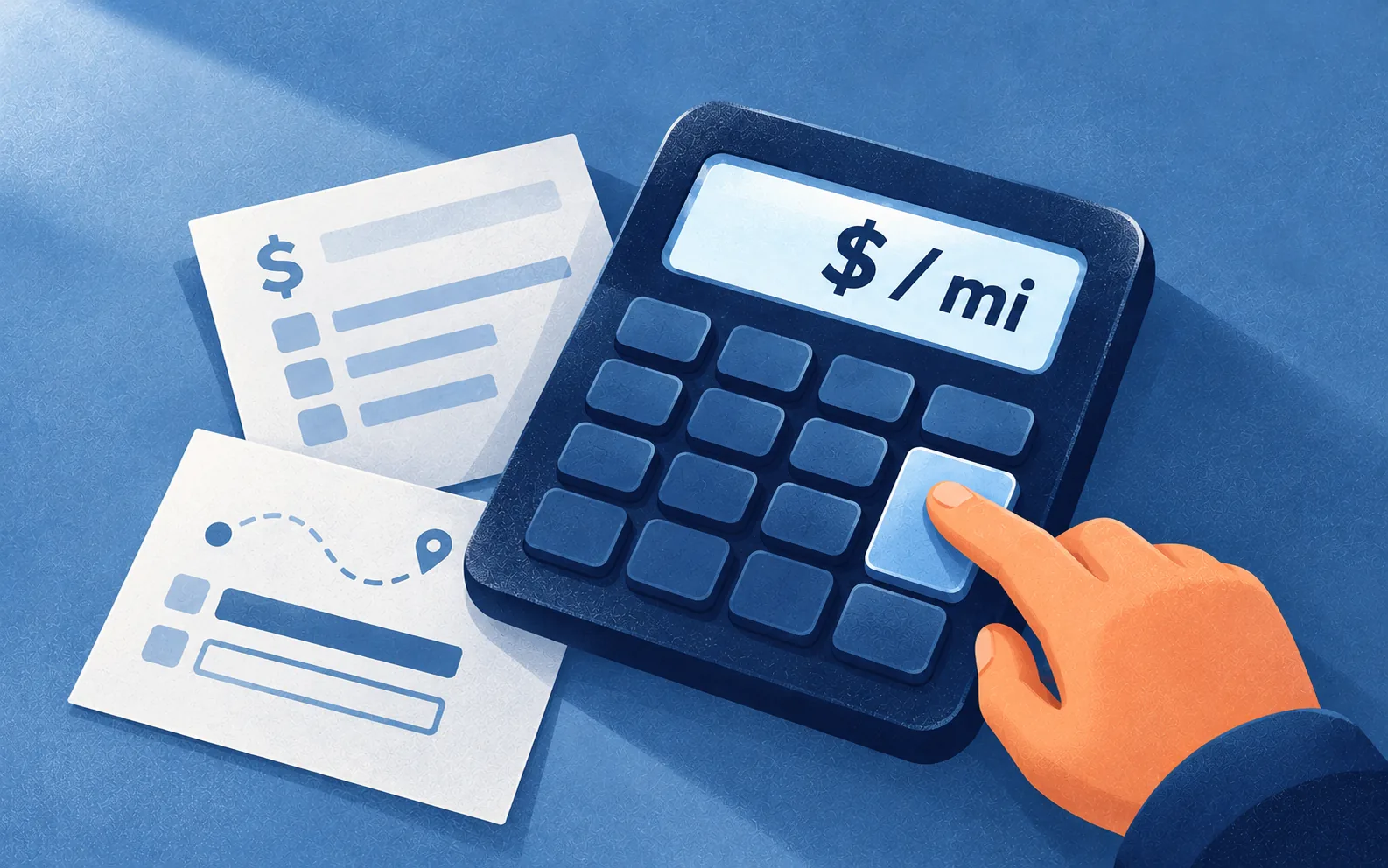
See what a long stop is worth. The defaults use a two-hour free time and ATRI’s median truckload rate of $50 an hour, billed in 15-minute steps. The math runs in your browser.
Bill it every time, and keep score
Detention that is never invoiced can’t be paid. Most fleets already charge it: ATRI found that 92% of fleets with 50 or fewer trucks charge detention fees.1 Charging it on every eligible stop is the harder part.
Keep a simple record by facility: how long trucks waited, what you billed, and what was paid. After a few months it shows you which shippers and receivers cost you the most time. That gives you a reason to price those loads higher, ask for a better appointment, or turn the freight down. In OOIDA’s survey, some owner-operators said they stop hauling to facilities that detain them over and over.3
The rules may help with hours, though not with pay. FMCSA plans a pilot program in 2027 that lets drivers pause their 14-hour clock for 30 minutes to 3 hours during a pickup or delivery.10, 11 It may protect some driving time, but no federal rule requires shippers or brokers to pay detention. That is still up to your contracts and your paperwork.
Let the records do the work
Detention claims fail on timing. The truck’s location history is in the ELD, the terms are in the rate confirmation, and the broker’s replies are in email or a group chat. By the time someone lines them up, the claim window has often closed. Moonin connects your systems, inboxes, and conversations, and flags what needs your attention while you can still act on it. If you want to see what it would catch on your own loads, book a call.
Sources
- American Transportation Research Institute, Costs and Consequences of Truck Driver Detention: A Comprehensive Analysis (PDF), September 2024, using 2023 data.
- U.S. Department of Transportation, Office of Inspector General, Estimates show commercial driver detention increases crash risks and costs, but current data limit further analysis, report ST2018019, January 31, 2018.
- OOIDA Foundation, 2023 Detention Time Survey (PDF), February 2024.
- FreightWaves, Understanding detention pay clauses, May 22, 2025.
- C.H. Robinson, Submit a detention request in Navisphere Carrier, checked October 18, 2026.
- J.B. Hunt, Standardized accessorials in Carrier 360, December 11, 2020.
- RXO, How carriers manage their freight in CoyoteGO, checked October 18, 2026.
- 49 CFR 395.26, ELD data automatically recorded.
- 49 CFR 395.22, Motor carrier responsibilities, paragraph (i) on keeping ELD records for six months.
- Federal Register, split duty period pilot program notice, September 17, 2025.
- FMCSA, FMCSA advances hours of service pilot programs for America’s truck drivers, August 27, 2026.

The Moonin teamMoonin, Mason, Ohio